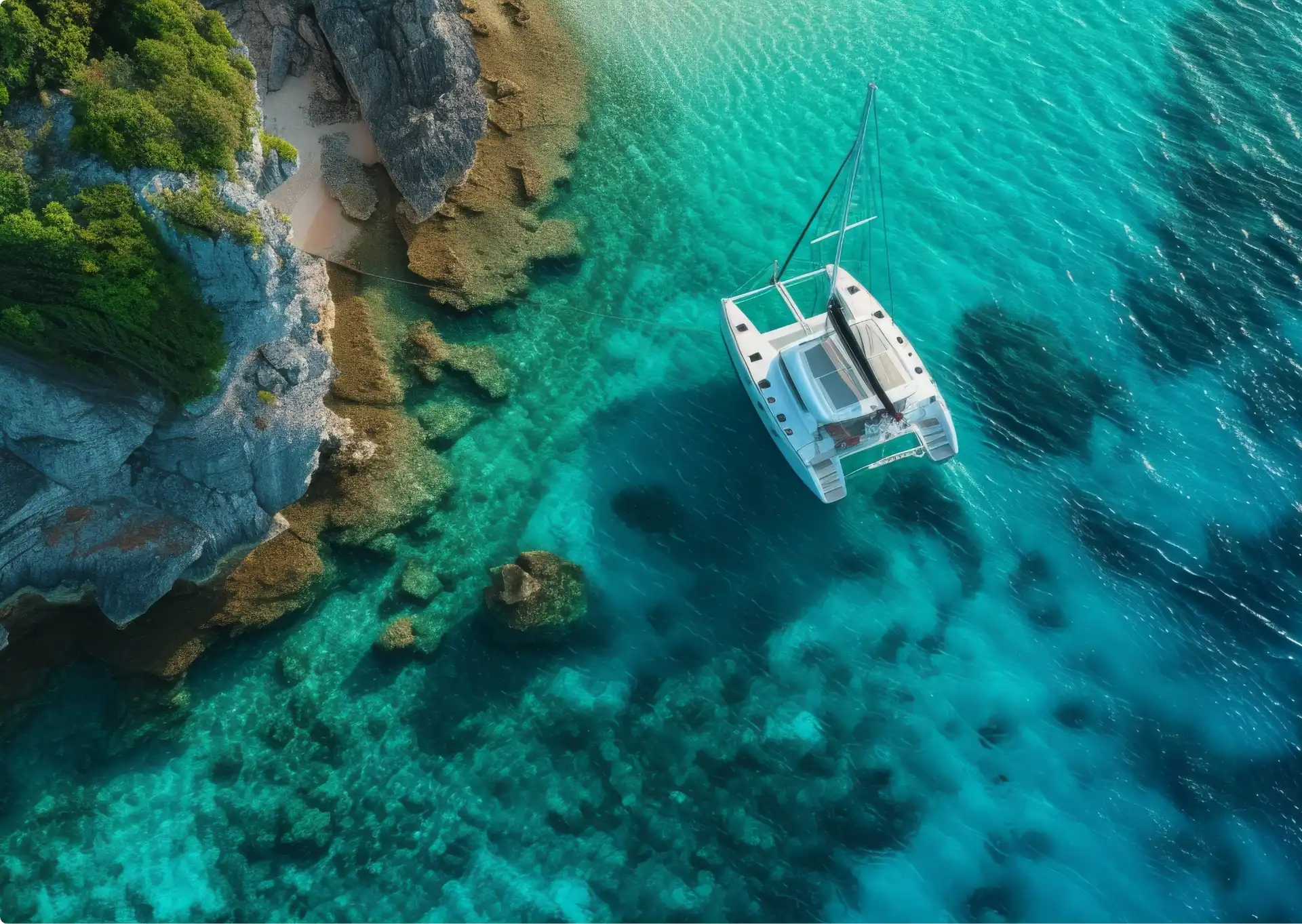
Catamarans Vs. Monohulls: Which Is Right For Your Next Adventure?
Choosing between a catamaran and a monohull yacht is genuinely one of the more consequential decisions in the boat buying process. It’s not just a technical question — it’s a lifestyle question. The two platforms attract different kinds of owners and serve different cruising patterns, and the right answer depends almost entirely on how you actually plan to use the boat.
Here’s an honest breakdown of both, from a team that brokers and sells both.
What Catamarans Do Best
The catamaran’s dual-hull design delivers advantages that are immediately apparent to anyone who’s spent time on one — particularly at anchor.
- Stability at anchor — the wide beam eliminates the rolling motion that makes life uncomfortable on a monohull in an anchorage. Drinks stay on the table. Sleep is better. This is the single quality catamaran owners mention most.
- Shallow draft — power catamarans typically draw 2.5–4 feet, opening up anchorages, sandbars, and inlets that a deep-keel monohull can’t reach. For Florida and Bahamas cruising, this is a meaningful operational advantage.
- Interior volume — the beam of a 45-foot catamaran rivals that of a 60-foot monohull. The salon, cockpit, and cabins feel significantly more spacious than the LOA suggests. Families and those who entertain frequently find this compelling.
- Fuel efficiency — lighter displacement and reduced drag mean catamarans typically burn less fuel than equivalent monohulls at the same speed. This advantage compounds on longer passages.
- Safety redundancy — twin hulls and twin engines mean a mechanical failure rarely strands you. Catamarans are inherently difficult to sink.
Where Catamarans Have Trade-Offs
- Docking and marina access — the wide beam that delivers stability and space complicates marina life. Many slips aren’t configured for cats, and those that are charge a premium (often billed at 1.5–2x the vessel’s LOA). In busy South Florida marinas, slip availability is genuinely constrained.
- Purchase price — comparable length-for-length, power catamarans cost 15–30% more than monohulls from equivalent builders. The price premium is real.
- Slamming in short chop — in steep, short-interval waves, the bridgedeck can slam against the water, creating a jarring impact that traditional monohulls avoid. Modern designs have reduced this significantly, but it remains a characteristic of the platform in certain conditions.
- Narrower buyer pool — when it comes time to sell, the catamaran market is smaller than the monohull market. Well-maintained cats from reputable builders hold value well, but the time-to-sale is typically longer.
What Monohulls Do Best
The traditional monohull yacht has earned its dominant position in the market over more than a century of development. It remains the right choice for a large portion of buyers.
- Performance and speed — deep-V and semi-displacement monohulls can reach speeds that most power catamarans can’t match without significantly larger engines. For buyers who value the ability to reposition quickly — crossing from Fort Lauderdale to the Bahamas in under three hours — monohulls often have the advantage.
- Handling in offshore conditions — many experienced offshore captains prefer the motion of a deep-V monohull in steep ocean swells. The vessel cuts through rather than riding over, which some find more predictable in heavy weather.
- Marina access — standard beam means standard slips, standard pricing, and access to virtually every marina on the East Coast and Great Lakes.
- Selection and value — the pre-owned monohull market is deep. More options, more price points, more builder variety, and a larger pool of buyers when you sell.
- Classic aesthetics — for owners who value traditional yacht styling, monohulls simply look the part in a way that catamarans — regardless of how capable they are — don’t replicate.
Where Monohulls Have Trade-Offs
- Rolling at anchor — without the beam of a catamaran, monohulls roll in beam seas and anchorages. Stabilizers help, but they add cost and complexity. This is the most common complaint from monohull owners who’ve spent time on catamarans.
- Draft restrictions — deep-keel and full-keel monohulls draw 4–6 feet or more, limiting access to shallow anchorages, the Bahamas banks, and parts of the ICW. Semi-displacement designs are better, but never as shallow as a catamaran.
- Interior volume relative to LOA — a 45-foot monohull feels smaller than a 45-foot catamaran, because it is. The beam difference is substantial.
Hybrid and Electric Options: Where the Platforms Diverge
If hybrid or electric propulsion is a priority — and for a growing number of buyers it is — the monohull market currently has more developed options in the production segment. Greenline’s hybrid motor yachts (39–58 feet) are the most established production hybrid platform in North America, combining diesel efficiency with electric operation, solar charging, and generator-free anchoring.
For buyers specifically interested in hybrid and electric yachts, the Greenline lineup offers a level of real-world validation — including silent anchoring capability — that the catamaran segment doesn’t yet match in production form. The first North American 100% electric Greenline 40 delivered by YSI is a marker of where the monohull hybrid market is heading.
Which Hull Type Fits Your Cruising Pattern?
The honest answer depends on where and how you cruise. Some practical guidance:
Catamaran is likely the better choice if you:
- Spend significant time at anchor — Bahamas, Florida Keys, Caribbean
- Cruise as a family or regularly have guests aboard who prioritize stability and space
- Access shallow water anchorages as a primary activity
- Value interior volume over speed
- Plan extended liveaboard use where the stable platform matters daily
Monohull is likely the better choice if you:
- Make frequent offshore passages where speed and sea-keeping matter
- Cruise primarily from marina to marina rather than at anchor
- Value marina access over shallow draft capability
- Are interested in hybrid propulsion and want the most developed production options
- Prefer traditional yacht aesthetics and the deepest pre-owned market
Many buyers find the comparison sharpens quickly once they spend time on both platforms. If you haven’t been aboard a comparable catamaran recently, that’s the first step — the difference at anchor is difficult to convey in print.
What YSI Carries
YSI’s brokerage inventory spans both platforms. We carry catamarans for sale across multiple brands and price points alongside our broader motor yacht inventory. As an authorized Greenline dealer, we also offer the full hybrid motor yacht lineup for buyers specifically interested in that platform.
If you’re weighing the two types and want to discuss your specific cruising plans, our team can help you think through which platform actually fits — not which one is more impressive on paper. Contact us to start that conversation, or read more about how our brokerage process works.