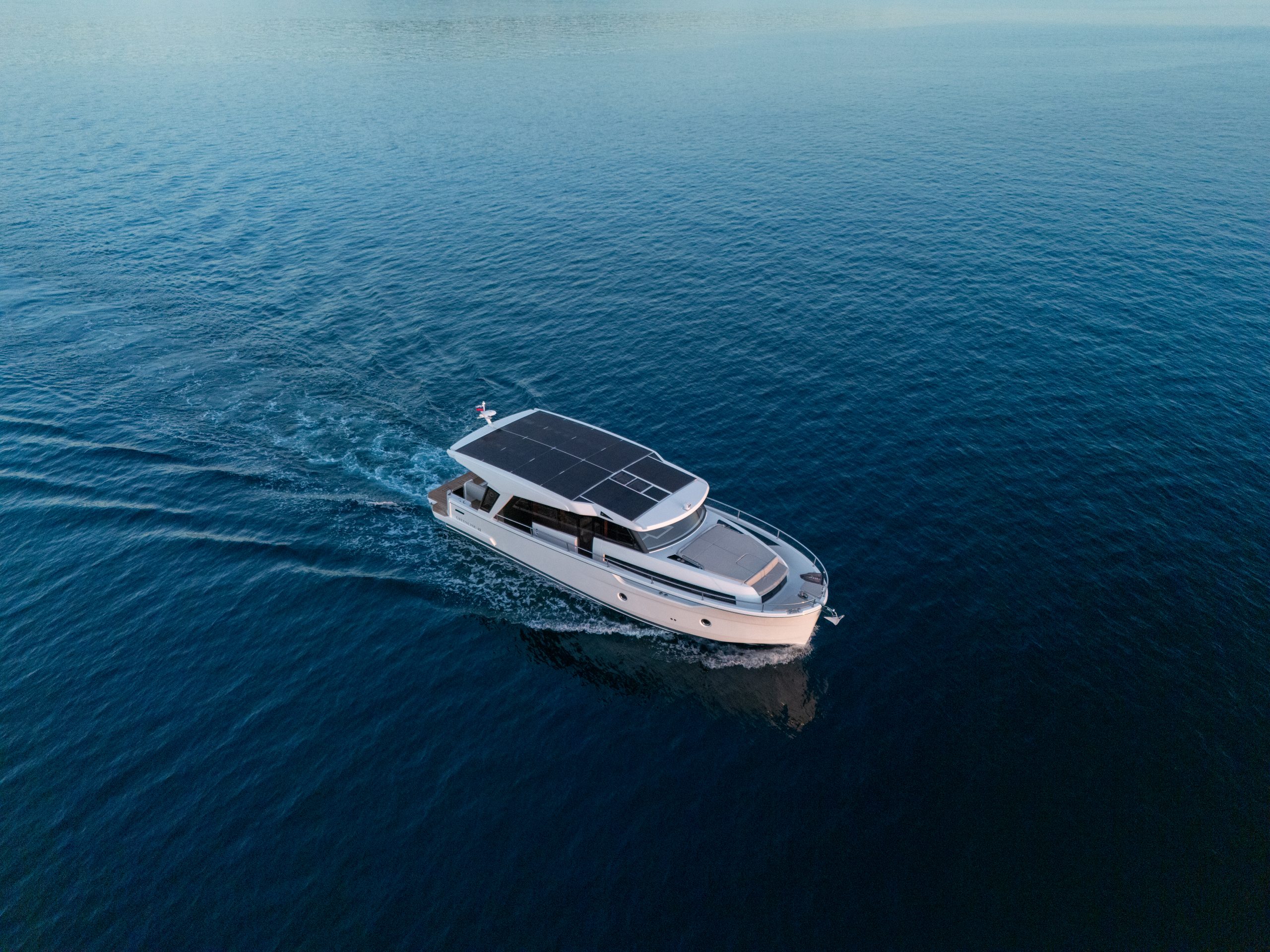
Hybrid vs. Diesel Yacht: What Every Buyer Needs to Know in 2026
I have been selling hybrid yachts since 2017. Before that, I was in the diesel world for many years. I have seen it from both sides.
Every week, a buyer asks us the same question. Is hybrid worth it, or is it just a marketing thing? I appreciate that question. It tells me the person is serious.
I am not going to tell you hybrid is the right answer for everybody. It is not. But I am going to tell you exactly what the difference is, so you can decide for yourself.
“The fuel savings are real. The environmental story is real. But I will tell you what closes most buyers we work with. It is the silence.”
How Hybrid and Diesel Propulsion Actually Work
Most people understand diesel. You burn fuel, you turn the propeller, you go. Simple. What confuses people is that “hybrid” means different things depending on who is selling it to you.
I have seen three architectures in the market. They are not the same thing. They perform very differently.
Serial Hybrid
In a serial hybrid, a diesel generator charges a battery bank. The battery bank powers the electric motors. The motors turn the shaft. The diesel never connects directly to the shaft at all.
Here is what makes this interesting. The generator only runs when the battery bank needs recharging. The rest of the time — silence. Even offshore. You run on battery power, the bank gets low, the generator kicks on for a while, tops it up, then goes quiet again. The more charge you carry in the bank, the longer you run without the generator. For buyers who want serious offshore range and still want to experience electric propulsion — this is the architecture that makes both possible today.
The S60e Revolution Edition, which we will have in Fort Lauderdale by the end of 2026, uses this architecture. It is built specifically for offshore passages where full-electric range is not yet realistic. The battery bank drives propulsion. The diesel generator is there to replenish it when needed. You get the electric experience — the quiet, the efficiency, the off-grid capability — with the range security of a generator behind you.
Parallel Hybrid — What Greenline Uses
This is the system I know best. I have been working with it since 2017. I have placed over 100 of these boats with buyers we have placed across the country. Greenline has delivered around 1,500 hulls total worldwide.
In a parallel hybrid, the diesel and the eUnit are both connected to the same shaft. You can run diesel. You can run electric. And here is something people do not expect: when you are running on the diesel, the electric motors become generators and recharge the battery bank. Solar does the same at anchor or underway. The system is always working.
At low speed, in a marina, at anchor — you run on electric. Nothing. Complete silence. For longer passages, the diesel takes over. The diesel runs at its best efficiency the whole time. It is not idling along for hours like on a conventional boat. As I said — as faster you push a diesel, as more efficient it runs. That is the opposite of what most people expect.
In real use, I see 20 to 30 percent fuel savings across a season. That is not a number from a factory test. That is what our owners report after a full year on the water.
Full Electric
No diesel. Batteries and solar only. I respect the idea. For the right customer with the right usage pattern, it works.
But I am honest with people. If you are planning to cruise to remote places, far from marinas, far from shore power — full electric is not there yet for that mission. The technology is improving every year, but today you need to be realistic about your itinerary.
What the Numbers Actually Look Like
Fuel
I will give you the honest range. Twenty to thirty percent fuel savings in real use. That is for a customer who is doing what most buyers we work with do — slow passages between anchorages, time at anchor, some faster runs in between.
If you are running fast all day every day, the savings are less. Hybrid is not a rocket ship. It is a cruising tool. It does its best work at displacement speeds.
The Inverter Story
Here is something most buyers do not know. Even on a Greenline that does not have the hybrid electric drive, the ownership experience is fundamentally different from a conventional motoryacht. Every Greenline runs its house loads — refrigeration, washer/dryer, cooktop, lighting, all of it — through an inverter system backed by a substantial battery bank charged by solar. The diesel engine does not need to run to keep the boat comfortable at anchor. The generator does not cycle on and off through the night. As I said, the inverter is the part of the story that most people overlook. The longer you spend on the boat, the more you appreciate it.
“A couple ordered a Greenline 45 Fly from me. They took delivery and they left. No shakedown cruise. Straight onto the Great Loop. Nine months. 6,000 miles. Over 750 hours on the twin Yanmars. Under 150 hours on the generator. I have been selling boats for 30 years. That number stopped me.”
On a conventional motoryacht doing the same trip, the generator runs constantly. For the air conditioning, the battery charging, the water heater, everything. You are looking at 1,000 hours easy. Maybe more.
The solar and the battery system on that boat handled almost everything. Hotel loads all day. All night. The generator was there for backup, and that is basically how they used it.
The savings in fuel were real. But when I spoke with the couple after the trip, they did not talk about the money first. They talked about the quiet. Nine months on the water without a generator running constantly. That is a different life.
Noise and Vibration
I always say: you cannot describe silence to someone who has never experienced it on a boat. You have to feel it.
A diesel boat vibrates. There is always a background noise. You get used to it. You think you do not notice it anymore. Then you step onto a hybrid vessel at anchor with the diesel off, and you realize how much noise you were living with.
I have had customers do a sea trial, come back to the dock, and say nothing for a moment. Then they ask where they sign. That is the moment I know they understand it.
Maintenance
Hybrid adds components. That is true. More components can mean more things to maintain. I will not pretend otherwise.
But here is what I also know. On a parallel hybrid, the diesel engine runs fewer hours per season. Fewer hours means longer service intervals. It means the engine lasts longer. The electric motor has no consumables at all. Greenline uses LiPo batteries rated for around 2,000 cycles.
The technology has matured a great deal since I started with Greenline in 2017. The service network is established. The parts picture is solid. This is not an experiment anymore.
What Happens to Your Investment
Buyers ask us about resale value. It is a fair question.
What I see in the used market: well-maintained Greenlines hold their value. Demand for pre-owned hybrid vessels is growing. Supply is not keeping up with that demand. That is a good position to be in as an owner.
But I will say this clearly. Not every “hybrid” listing is the same. The brand matters. The specific system matters. The service history matters. The battery state of health matters. A well-documented Greenline is a very different asset from an early experimental hybrid system with an uncertain parts picture. Know what you are buying.
Who Hybrid Is Right For
After nearly 10 years of placing customers into these boats, I know the profile well.
- Customers who spend serious time at anchor. Bahamas. Caribbean. The ICW. If you are anchoring regularly, electric operation changes your life on the water. No generator noise. No diesel smell. The difference is not small.
- Liveaboard owners. I know this life personally. Running hotel loads without starting the generator is not a convenience. It is a completely different daily experience. Solar charges the bank during the day. You sleep in silence at night.
- Buyers who cruise marina to marina. Shore power overnight plus solar during the day means many owners we work with almost never touch the diesel on shorter hops. The fuel bill reflects that.
- Long-term owners. The premium for hybrid is real. I will not pretend it is not. But a buyer who owns the boat for 8 to 10 years and uses it properly will see that premium come back through fuel savings, reduced engine hours, and strong resale demand.
- Buyers for whom silence is a priority. This is harder to put a number on. But for many buyers we work with, it is the most important thing on the list. Hybrid delivers something diesel fundamentally cannot.
Where Hybrid Is Probably Not the Right Fit
- Long offshore passages to remote destinations. The simplicity of diesel and the availability of diesel fuel globally is a real argument. We have had this conversation with buyers who spend serious time far offshore. It deserves an honest answer.
- Buyers focused only on initial price. The hybrid premium is real. If your budget is the primary constraint and your usage is modest, a diesel vessel may make more sense on a pure cost basis. I would rather tell you that now than have you regret the purchase.
- High-speed powerboat buyers. Parallel hybrid does its best work at displacement speeds. If your priority is going fast, the fuel savings case weakens significantly. It is the wrong tool for that job.
My Recommendation
Hybrid is not for everybody. I have said that from the beginning. But for the customer who anchors regularly, values quality of life on the water, and plans to own their boat for the long term — the case for parallel hybrid propulsion is strong. And it gets stronger every year.
Here is what I tell every buyer who asks me this question. Do not decide from a brochure. Come for a sea trial on a Greenline. Not a walk-through at a dock. A real sea trial, on electric with the diesel off. That experience will answer the question better than anything I can write here. As I said at the beginning — you cannot describe silence. You have to feel it.
“I have been working with Greenline since 2017. We have sold more Greenlines than any other dealer in the world. I say that not to boast — I say it because that experience is what a buyer gets when they call us. If you are evaluating hybrid propulsion, you will not find a more experienced team.”
Explore our Hybrid & Electric Guide or browse current Greenline inventory — or call us at 954.642.2080.
In real-world use, a parallel hybrid yacht like the Greenline 45 Fly saves approximately 20 to 30 percent on main engine fuel compared to an equivalent conventional diesel vessel. At 150 engine hours per season and $5.50 per gallon, that works out to roughly $1,650 per year in main engine fuel savings. The bigger number is generator fuel — a hybrid’s inverter and solar system can reduce generator hours from 750 or more per season to under 50, saving an additional $2,000 to $2,500 annually.
In a parallel hybrid, the diesel engine and electric motor are both mechanically connected to the propeller shaft. You can run on diesel, electric, or both simultaneously. When running on diesel, the electric motor acts as a generator and recharges the battery bank. Solar panels add continuous charging. In a serial hybrid, a diesel generator charges a battery bank, and the battery bank powers the electric motors — the diesel never connects directly to the shaft. Parallel hybrids deliver the best efficiency at cruise speeds; serial hybrids offer more flexibility for extended electric-only range.
Greenline uses LiPo (lithium polymer) batteries rated for approximately 2,000 charge cycles to 80 percent of original capacity. In typical usage — partial cycles, well-managed charging — real-world service life often exceeds the rated cycle count. Most owners will not need to replace their battery bank within the first 8 to 10 years of normal use. When replacement is needed, it is a known, plannable cost rather than an unexpected failure.
Yes. Every Greenline runs its house loads — refrigeration, washer/dryer, cooktop, lighting, and other systems — through an inverter backed by a battery bank charged by solar panels. The diesel engine does not need to run to keep the boat comfortable at anchor. The generator does not cycle on and off through the night. This is one of the most significant quality-of-life advantages of the Greenline system.
Well-maintained hybrid vessels — particularly Greenlines — have held their value well in the used market. Demand for pre-owned hybrids is growing faster than supply, which supports pricing. The caveat: the specific model, service history, and battery state of health all affect resale. A Greenline with complete service records and a healthy battery bank commands a premium.
Yes, when the system is properly maintained and the boat is appropriately sized for the passage. Greenline models with hybrid drive carry CE Category B certification (offshore) and owners regularly complete extended passages including ICW and Great Loop routes. The parallel hybrid architecture means you always have the diesel as primary propulsion — the hybrid system adds capability without removing the conventional safety net.